Designing with Hand-Drawn Flowers Seamless Patterns
In a digital world saturated with sharp vectors and perfect gradients, there is a distinct hunger for the imperfect, the organic, and the human touch. This is precisely where Hand-Drawn Flowers Seamless Patterns carve out their niche. Far from the rigid geometry of standard corporate design assets, this collection offers a breath of fresh air—literally and figuratively. It captures the delicate beauty of botanical illustration combined with the subtle, tactile quality of light watercolor textures. For the creative professional, this isn't just a set of images; it is a versatile toolkit for softening hard edges and adding emotional depth to visual communications.
The Aesthetic: Organic Charm Meets Technical Precision
When we talk about the visual personality of this set, we are looking at a specific blend of whimsy and utility. The "hand-drawn" aspect is crucial here. Unlike rigid, machine-generated vectors, these patterns feature the slight irregularities and linework variations that signal authenticity. They feel human. However, the "seamless" technical specification is what elevates them from a mere sketch to a professional design asset.
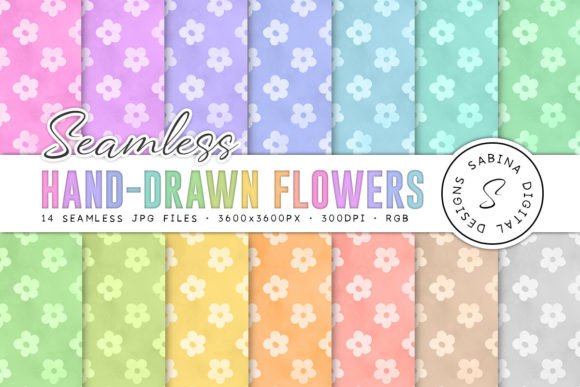
The collection provides 14 distinct variations, ensuring that you aren't stuck with a one-note background. The pastel palette is intentionally muted, designed to sit back and support foreground content rather than compete with it. The "very light watercolor texture" mentioned in the specifications is the secret weapon. It adds a layer of sophistication and depth that flat colors lack. It mimics the bleed and absorption of real pigment on paper, which triggers a subconscious association with craftsmanship and care.
For designers, this style sits in a unique middle ground. It is distinct enough to establish a mood but subtle enough to function as a background. It avoids the "clip art" look by maintaining high-resolution integrity (300 DPI at 12x12 inches), meaning the brush strokes and petal details remain crisp even upon close inspection.
Strategic Applications: Beyond Scrapbooking
While the specifications explicitly mention scrapbooking and card making, limiting these patterns to traditional hobbies would be a strategic mistake for any entrepreneur or marketer. The versatility of Hand-Drawn Flowers Seamless Patterns extends into high-level branding and commercial design.
Consider the current trends in brand identity. Many modern brands, particularly in the wellness, beauty, lifestyle, and boutique food sectors, are moving away from cold, corporate aesthetics. They want to appear approachable and grounded. Using these patterns as website backgrounds or section dividers can instantly soften a brand's digital presence. In web design, a light floral pattern behind a "About Us" or "Testimonials" section can guide the eye without the heaviness of a solid color block.
For packaging design, these assets are invaluable. If you are a small business owner creating labels for handmade soaps, candles, or artisanal goods, a seamless pastel pattern creates an instant shelf appeal. It communicates "natural" and "handmade" before the customer even reads the label text. Similarly, in editorial design, these patterns work beautifully as endpapers for booklets, backgrounds for pull quotes, or borders for magazine layouts.
Technical Workflow and Integration
Understanding the file specifications is key to a smooth workflow. The provided dimensions—3600x3600 pixels at 300 DPI—translate to a 12x12 inch print size. This is the industry standard for high-quality digital scrapbooking paper, but its utility goes further.
Because the files are JPGs, they are lightweight and compatible with virtually every design software on the market, from Adobe Photoshop and Illustrator to Canva, Procreate, and Affinity Designer. The RGB color mode is optimized for screen display, making these perfect for social media graphics, digital presentations, and website headers. If you are planning to print these commercially, it is standard practice to convert the color profile to CMYK in your layout software to ensure the pastels don't shift unexpectedly on press.
The "seamless" nature of the tile is perhaps the most practical feature. In a tool like Photoshop or Illustrator, you can define this pattern and apply it to any shape or canvas size. This ensures consistency across your marketing materials. You can create a cohesive ecosystem where your Instagram story, your email newsletter header, and your printed flyer all share the same visual thread, reinforcing your brand identity through repetition and style.
Pairing and Typography Strategy
A background is only as good as the text that sits on top of it. When working with the visual complexity of a floral pattern, even a subtle one, your typography choices become critical for readability.
Because these patterns have a hand-drawn, organic personality, they pair exceptionally well with clean, geometric typefaces. A modern sans serif font with clean lines creates a beautiful contrast against the organic florals. Think of fonts like Montserrat, Lato, or Futura; their neutrality allows the pattern to shine while keeping the message legible.
Conversely, you can lean into the theme by pairing the background with a handwritten font or a script font, but caution is required. If the background is busy and the font is too ornate, you lose hierarchy. The solution is to use the script font for large, spaced-out headers (like a logo design or a main title) and switch to a serif font or sans serif font for body copy. This creates a clear visual hierarchy that guides the reader from the headline to the details.
For example, if you are designing a wedding invitation, you might use a flowing script for the names but a classic serif for the venue details. The floral pattern acts as the unifying element that ties the different typographic styles together.
Evaluating Fit and Commercial Use
Before integrating any premium font or asset into a project, a professional must evaluate the fit. Ask yourself: Does this pattern align with the personality of the message? Hand-Drawn Flowers Seamless Patterns evoke feelings of spring, femininity, gentleness, and nature. They are an excellent fit for a yoga studio, a florist, a children’s clothing brand, or a wedding planner. They might be less appropriate for a heavy industrial firm or a cybersecurity startup, where sharp angles and dark tones are preferred to convey strength and security.
When testing these patterns, create a mockup early in the design process. Place your logo and your primary text blocks over the pattern. Check the contrast. Because the pastel backgrounds are light, dark text (black or deep charcoal) will offer the best legibility. Avoid using light grey or pastel text directly on top of the pattern, as it will disappear into the texture.
Finally, regarding commercial licensing: always ensure that the asset you are using is cleared for your specific intended use. If you are creating a product for sale—such as a printable planner or a physical mug—you need to ensure the license covers commercial reproduction. Most reputable asset providers allow for this, but it is the mark of a responsible creator to verify the terms. By treating these design assets with professional respect, you ensure that your final product is not only beautiful but also legally sound.
In conclusion, the value of this collection lies in its ability to bridge the gap between digital precision and analog warmth. By leveraging the Hand-Drawn Flowers Seamless Patterns thoughtfully, you can elevate a standard layout into a memorable, tactile experience for your audience.