Colors & Shapes Activities for Preschool: A Hands-On Learning Binder
When you’re designing educational materials for the youngest learners, the challenge isn’t just making them cute—it’s making them functionally effective. We often get caught up in the aesthetics of a layout, focusing on kerning and leading, but for preschoolers, the "user experience" is entirely tactile and visual in the most literal sense. This is where the concept of a "busy binder" changes the game. It moves beyond static worksheets and introduces a dynamic element to the curriculum. The "Colorful Creations: Busy Binder for Color & Shape Activities" represents a shift toward modular, interactive design in early childhood education.
The Architecture of Early Learning
At its core, this collection of Colors & Shapes Activities for Preschool is built on the principle of differentiation. In the world of typography and publishing, we talk about adaptability; in the classroom, it’s about meeting a child exactly where they are. This binder isn't a one-size-fits-all PDF. It includes three distinct levels of differentiation for writing and tracing, acknowledging that fine motor skills vary wildly between a three-year-old and a five-year-old.
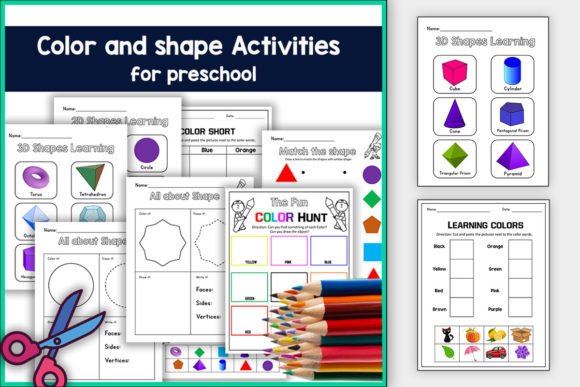
Visually, the design relies on clarity. There are no distracting watermarks or overly complex illustrations competing for attention. The gumball machines, paint palettes, and geometric shapes are rendered with high contrast and clean lines. This isn't just an aesthetic choice; it’s a functional one. By keeping the visual hierarchy clean, the activities allow the child to focus on the cognitive task—matching red to red, or distinguishing a circle from a square—without visual noise. The inclusion of both "grey" and "gray" spellings also shows a nuanced understanding of localization and audience diversity, a detail often overlooked in mass-market educational printables.
Tactile Interaction: Beyond the PDF
One of the most compelling aspects of this resource is the assembly requirement. You aren't just handing a child a stack of papers; you are creating a reusable tool. The instructions call for a laminator, velcro strips, and a hole punch. This turns a digital asset into a permanent piece of classroom furniture or homeschool equipment.
From a production standpoint, this is brilliant for longevity. Laminating the pages transforms the Colors & Shapes Activities for Preschool into a dry-erase surface. The velcro dots allow for loose pieces to be stored directly on the page, solving the immediate problem of lost puzzle pieces. This kind of design thinking—anticipating the user's pain points (lost pieces, torn paper)—is what separates a mediocre resource from a premium one. It’s the difference between a disposable flyer and a bound hardcover book; one is meant to be consumed, the other to be kept.
Strategic Implementation in Diverse Environments
For educators and homeschooling parents, time is the most valuable currency. The versatility of this binder allows it to slot into different parts of the day without friction. It works seamlessly as "morning work"—that crucial 15-minute window where teachers need students to be independent while attendance is taken. Because the activities are self-correcting (the shapes only fit in the right spots, the colors only match when aligned), the child receives immediate feedback without adult intervention.
However, the utility extends beyond the classroom. For designers and content creators in the educational niche, this binder serves as a case study in product bundling. It combines color theory with geometry, offering a holistic approach to early visual literacy. The structure of the Colors & Shapes Activities for Preschool—moving from simple matching to tracing and finally to independent writing—mirrors the cognitive scaffolding used in professional curriculum development. It shows a progression of complexity that respects the learner's developmental stage.
Design and Production Quality
The specifications are standard for professional printing: 8.5x11 inches, delivered in both PDF and JPG formats. This dual-format delivery is practical. The PDF ensures that vectors and text remain crisp when printed, while the JPG offers flexibility for those who might want to import the pages into digital planning apps like GoodNotes or use them as backgrounds for digital stickers.
The 32-page count is substantial. It provides enough variety to keep the "Color & Shape" unit going for weeks without the content feeling stale. For a small business owner creating curriculum kits, or a blogger offering digital downloads, the depth of this collection adds significant perceived value. It’s not just a single worksheet; it’s a comprehensive system.
Final Thoughts on Visual Literacy
Ultimately, tools like the Colors & Shapes Activities for Preschool are doing more than teaching a child to identify a triangle. They are laying the groundwork for visual literacy. They are teaching children to observe, categorize, and manipulate visual information. Whether you are a parent looking for a quiet activity, a teacher managing a classroom of 20, or a curriculum designer looking for inspiration, this binder offers a robust, hands-on solution to the timeless challenge of early education. It proves that with the right materials, learning can be as sticky and colorful as the velcro dots holding it all together.